
The Hidden Danger of Temporary Solutions in Commercial Fire Safety
6/23/2026
6/23/2026
You are walking through your commercial facility and notice a heavy fire door wedged open with a wooden block. Down the hall, an extension cord stretches across the warehouse floor, plugged directly into another power strip to keep a temporary workstation running. You make a mental note to fix these issues later, assuming they are just harmless temporary solutions to get your team through a busy shift.
Fast forward two weeks, and those temporary fixes are still there. The local fire marshal walks in for a surprise inspection, spots the wedged door and the daisy chained cords, and immediately writes a massive citation. Worse, if an actual fire breaks out tonight, those exact workarounds will actively accelerate the destruction of your building. Commercial fire codes do not recognize temporary convenience. Before a quick fix turns into a permanent liability or a devastating facility fire, here is your guide to identifying the most common hazard workarounds and how to permanently correct them.
If your staff is currently utilizing makeshift hardware solutions to bypass daily operational friction, you must take immediate action to restore your building's safety infrastructure.
Facility managers often view fire safety as a static checklist. They assume that because the alarms and sprinklers were installed correctly ten years ago, the building is perpetually safe. In reality, the daily habits of your employees constantly alter the hazard profile of your building. Here is exactly why these common temporary fixes are so dangerous.
An employee wedges a heavy corridor or stairwell door open to improve warehouse airflow, or simply to make carrying inventory boxes easier without having to swipe a keycard every time. These seemingly harmless "quick fixes" can have some serious implications.
Fire doors are highly engineered barriers designed to compartmentalize a commercial building. They are rated to contain smoke, toxic gases, and extreme heat to one specific area for a legally mandated amount of time. By propping the door open, you completely destroy the building's passive fire defense system.
In an emergency, that open doorway acts as a massive vacuum. It will actively draw toxic smoke and superheated gases out of the room of origin and pump them directly into your primary evacuation routes. This traps your occupants inside the building and guarantees a massive negligence lawsuit against the property ownership.
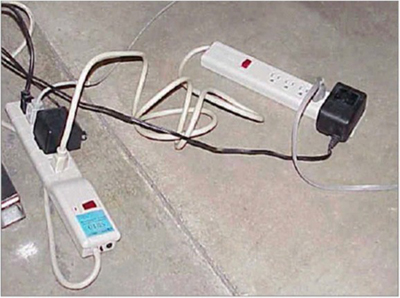
Let us know if you've heard of this one before: A temporary shipping desk needs to power three computers and a label printer, but there is only one wall outlet nearby. An employee plugs a cheap power strip directly into the end of a heavy duty extension cord to reach the desk.
Standard commercial electrical circuits are mathematically calculated for specific localized loads. Daisy chaining creates severe, uncalculated electrical resistance. The secondary power strip actively attempts to pull more amperage through the primary extension cord than the internal copper wiring is rated to handle.
The wires inside the primary cord will rapidly overheat, melting the outer plastic insulation from the inside out. This creates a silent, smoldering electrical fire that usually ignites under a desk, inside a drop ceiling, or behind a filing cabinet where your overhead sprinklers cannot immediately reach it.
Occasionally, we find that someone is using a zip tie to anchor a loose ethernet cable to the red sprinkler pipe running across the ceiling. In retail settings, managers might hang promotional banners or holiday decorations directly from the sprinkler drops.
Commercial fire sprinkler pipes and their mounting brackets are engineered to hold the exact weight of the pipe and the water inside it, plus a specific seismic tolerance. They are never designed to bear secondary loads.
Adding unauthorized weight to a sprinkler pipe puts severe stress on the threaded fittings and the ceiling hangers. A heavy pull on that ethernet cable can snap a CPVC fitting or misalign the sprinkler head. This will result in a catastrophic localized flood that destroys your inventory and completely disables your fire suppression system.
Some of our techs will walk into a job site and see that a plastic grocery bag or a specialized dust cap is wrapped tightly around a lobby smoke detector. Nothing makes them shake their heads more.
General contractors frequently cover smoke detectors to prevent construction dust or paint fumes from triggering a false alarm while they renovate a space. However, when the job is done, contractors forget to remove the temporary covers frequently.
That specific zone of your commercial fire alarm system is now completely blind and entirely useless. A fire could burn unattended for several minutes before enough heat escapes the room to trigger a different, unprotected detector down the hall. Those lost minutes are the critical difference between a minor localized incident and a total facility loss.
LIABILITY WARNING: Ignorance of a temporary hazard is not a valid legal defense. National Fire Protection Association (NFPA) 1 and NFPA 101 Life Safety Codes mandate that all egress paths, electrical systems, and life safety devices remain fully operational and unobstructed at all times. If a fire occurs and the investigation reveals that a propped door or a blinded detector contributed to the damage, your commercial property insurance carrier will likely deny your claim entirely.
We get it: Facility managers have entirely too much on their plates to catch every single operational hazard hidden across a massive commercial property. You need a second set of highly trained eyes to audit your life safety systems and keep your building legally compliant.
At Hedrick Fire Protection, our licensed technicians see the hazards that your daily staff misses. We provide Comprehensive Fire Sprinkler Inspections to ensure your overhead pipes are clear of unauthorized loads, properly supported, and fully operational. We conduct rigorous Fire Alarm Service and Testing protocols to uncover blinded, outdated, or malfunctioning detectors before the fire marshal does. If your daily facility operations have outgrown your original safety design, we can engineer and install the necessary system expansions so your staff never has to rely on dangerous electrical workarounds again.
Are temporary workarounds putting your commercial property at risk of a massive fine? Do not wait for a surprise inspection to find out. Click here to contact the Fire Alarm and Sprinkler Inspection Team at Hedrick Fire Protection to schedule a complete facility audit today.